The Physics of Cognition is the theoretical foundation paper for the A2 System. Where the A2 System framework describes what attention and intention are and how to use them, this paper argues why they may operate at the level of statistical physics, maps candidate biological hardware, and sketches a blueprint for engineering them into machines.
The Central Claim
Attention and Intention have been treated as powerful but metaphorical concepts siloed in different disciplines. This paper unifies them using a single equation from Karl Friston's Free Energy Principle:
G(pi) = SUM [D_KL(Q(o|pi) || P(o))] + E_Q[H(P(o|s))]
The first term (KL divergence) = Intention. Analogized to gravity: the goal state acts like a massive object warping state space, pulling the agent toward it.
The second term (expected entropy) = Attention. Analogized to conductivity: if Intention is voltage (potential difference), Attention is conductivity determining how much current (information) flows.
The Risk/Ambiguity decomposition itself is an established mathematical result, not a metaphor. Mapping the first term to Intention and the second to Attention is the interpretation this paper proposes. The brain update equation is:
mu_dot = gradient of G - Precision x prediction error
Where Precision (Pi) is attentional gain and gradient of G is intention drive. Because the update is multiplicative in precision, if either factor is near zero the belief update collapses. This motivates the framework's core claim: "High Intention + Zero Attention = Nothing" and "High Attention + Zero Intention = Efficient Irrelevance."
The Unified Mathematical Mapping
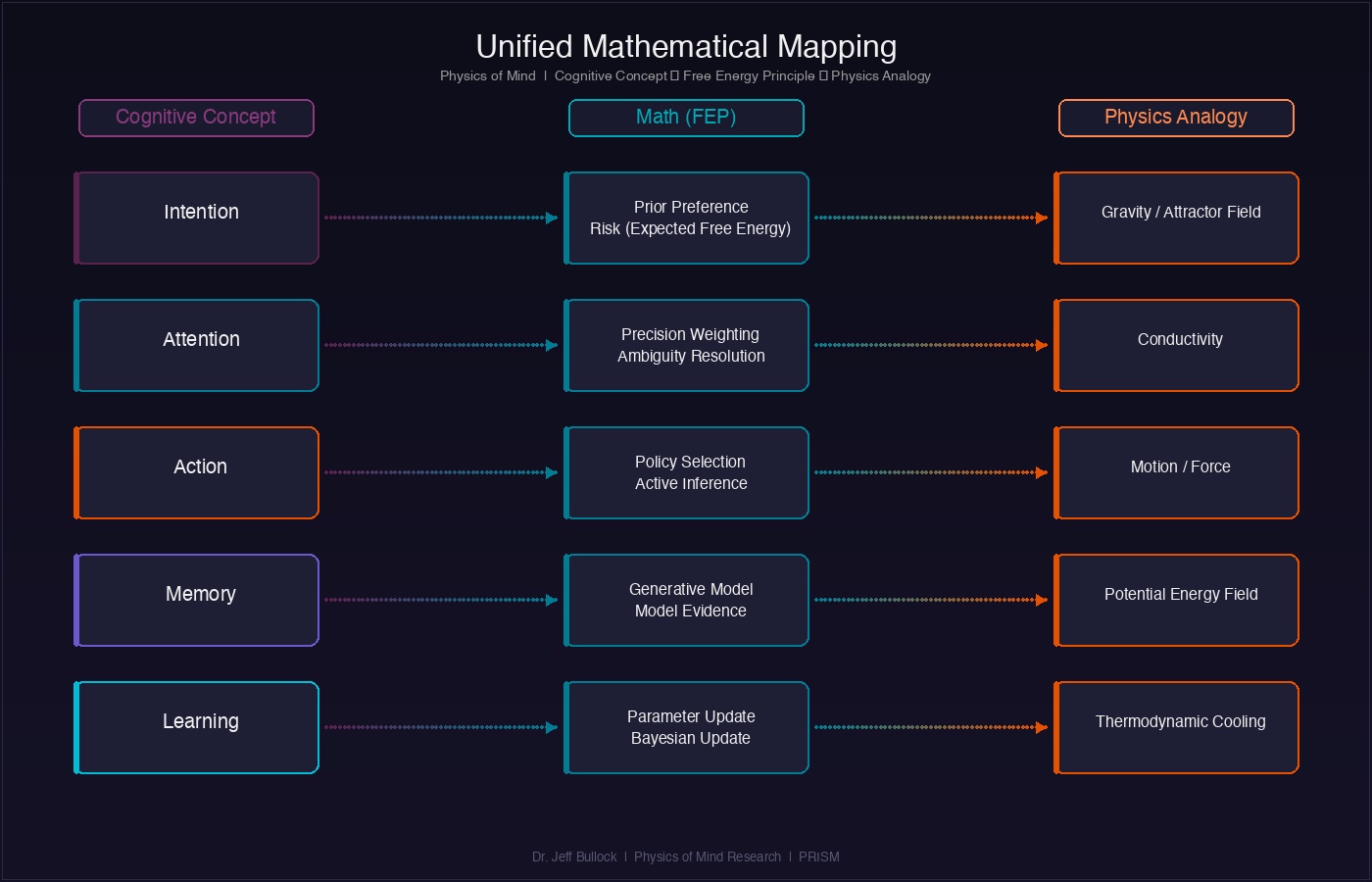
| Cognitive Concept | Math (FEP) | Control Theory | Physics Analogy | |---|---|---|---| | Intention | Prior Preference Matrix / Risk | Reference Signal / Set Point | Attractor Field (Gravity) | | Attention | Precision / Inverse Variance | Kalman Gain / Feedback Gain | Conductivity | | Action | Policy Selection minimizing G | Control Signal | Motion (Kinetic Energy) | | Conflict | High Entropy / High Free Energy | Error Signal | Potential Energy | | Willpower | Precision of the Policy | Actuation Force | Power (Work/Time) |
The Biological Hardware
| Variable | Neural Substrate | Neurotransmitter | Function | |---|---|---|---| | Intention P(o) | dlPFC / Basal Ganglia | Dopamine (Phasic) | Goal Maintenance, Value Encoding | | Attention (Pi) | TRN / Parietal Cortex | Norepinephrine / ACh | Sensory Gating, Precision Weighting | | Action Selection | SMA / Motor Cortex | Dopamine (Tonic) | Threshold Crossing, Movement Initiation | | Cost Function (F) | ACC | Adenosine / Metabolic Depletion | Conflict Monitoring, Effort Calculation |
The double dissociation is confirmed pharmacologically: dopamine manipulation affects willingness to work (intention) without affecting signal detection; NE/ACh manipulation affects signal detection (attention) without affecting motivation.
Supporting Research System
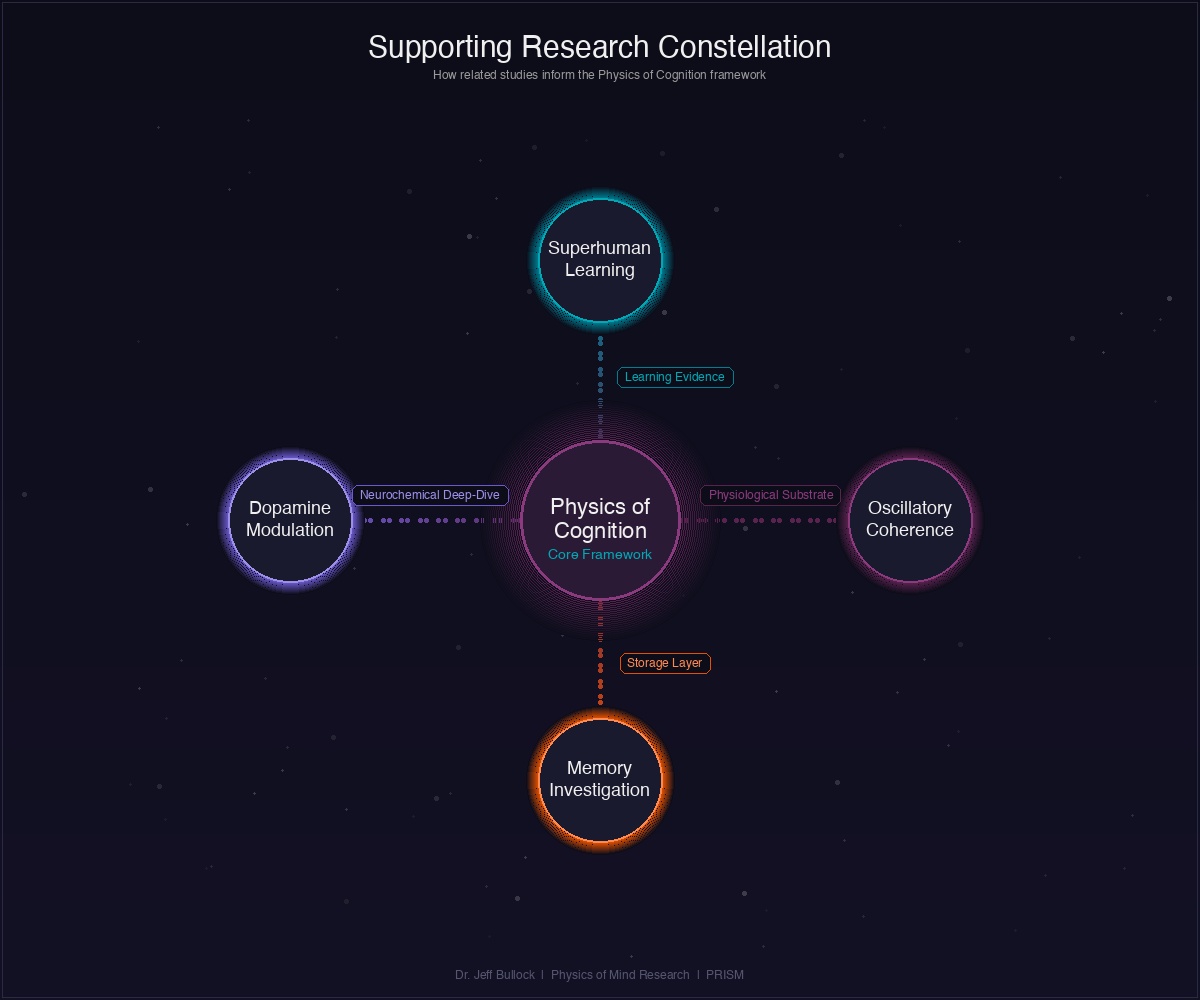
The Physics of Cognition sits at the center of a constellation of supporting deep research:
Superhuman Learning: AI-Enhanced Cognition. The learning science evidence base. Spaced/distributed practice (a robust medium effect across meta-analyses, d ≈ 0.46 to 0.54; Donovan & Radosevich, 1999; Cepeda et al., 2006), retrieval practice (reliably outperforms restudy), interleaving (g = 0.42; Brunmair & Richter, 2019), and implementation intentions (d = 0.65 across 94 tests; Gollwitzer & Sheeran, 2006). Shows HOW the brain's encoding/retrieval system optimizes when attention and intention are properly directed.
Oscillatory Coherence and Resonance in Human Biological Rhythms. The physiological substrate. Communication-through-Coherence theory (Fries, 2015). Heart-brain coupling data (Sargent et al., 2024). The 0.1 Hz cardiovascular resonance frequency. Interpersonal neural synchrony via hyperscanning. Provides the biological conditions for the equation to operate and supports the scaling of the We-Intention Vector to groups.
Memory: A Cross-Disciplinary Investigation. The storage layer. From synaptic plasticity to Landauer's Principle (erasing 1 bit costs minimum energy). If information is physical, then attention (precision weighting of information) and intention (preference distributions over states) are physical forces operating on physical substrates.
Dopamine Modulation in the Digital Age. The neurochemical deep-dive into the Intention side of the equation. Reward Prediction Error as the biological implementation of KL divergence. Tonic vs. phasic dopamine. Hedonic adaptation and allostasis. The dopamine impact matrix mapping green (exercise, sleep, social) vs. red (social media, notifications, pornography) regulation patterns.
What Makes This Different from the A2 System
| Dimension | A2 System (Framework) | Physics of Cognition (Theory) | |---|---|---| | Nature | Practical coaching framework | Theoretical physics paper | | Audience | Entrepreneurs, coaches, leaders | AI researchers, neuroscientists, academics | | Core question | "How do I harness these forces?" | "Can we write a single equation that unifies them and build machines that possess them?" | | Equations | Minimal | Central (EFE, Intention Index, We-Intention Vector) | | AI component | Minimal | Central (The Intention Engine architecture) | | Physics analogy | Metaphorical | Formal analogies (proposed) | | Measurability | Qualitative (coaching outcomes) | Quantitative (pupillometry-based Intention Index) |
The A2 System is the practitioner's field manual. Physics of Cognition is the proof that the field manual is grounded in real physics, plus a blueprint for engineering these forces into AI.
Candidate IP
The paper describes a candidate "Dual-Force Optimization Engine" for AI and Human-Computer Interaction (described as potentially patentable; not filed or examined) that explicitly separates and optimizes Epistemic Value (Attention/Curiosity) and Extrinsic Value (Intention/Goal) using a dynamic, biologically plausible precision-weighting mechanism.
Selected References
- Friston, K. (2010). The free-energy principle: a unified brain theory? Nature Reviews Neuroscience, 11(2), 127-138.
- Fries, P. (2015). Rhythms for cognition: Communication through coherence. Neuron, 88(1), 220-235.
- Posner, M. I., & Petersen, S. E. (1990). The attention system of the human brain. Annual Review of Neuroscience, 13(1), 25-42.
- Sargent, K., et al. (2024). Heart-brain coupling: Phase-amplitude analysis of EEG and HRV signals.
- Lennie, P. (2003). The cost of cortical computation. Current Biology, 13(6), 493-497.
- De Vivo, L., et al. (2017). Ultrastructural evidence for synaptic scaling across the wake/sleep cycle. Science, 355(6324), 507-510.
- Schultz, W. (2023). Dopamine reward prediction error coding. Dialogues in Clinical Neuroscience.
Status
Working paper. The formal academic version (Bullock, 2026) includes full citations from Friston (2010), Da Costa et al. (2020), Posner & Petersen (1990), Busemeyer & Townsend (1993), and explicit separation of established science, novel contributions, and speculative extensions.
Author: Dr. Jeff Bullock, PharmD | ORCID: 0009-0009-2053-4854
Access the Research
Download Full Paper (PDF) via Zenodo DOI: 10.5281/zenodo.19451662
- Format: White paper (self-published preprint)
- License: CC BY 4.0
- DOI: 10.5281/zenodo.19451662
Bibliography
- Friston, K. (2010). The free-energy principle: a unified brain theory? Nature Reviews Neuroscience, 11(2), 127-138.
- Da Costa, L., Parr, T., Sajid, N., Vesber, S., Ryan, V., & Friston, K. (2020). Active inference on discrete state-spaces: A synthesis. Journal of Mathematical Psychology, 99, 102447.
- Posner, M. I., & Petersen, S. E. (1990). The attention system of the human brain. Annual Review of Neuroscience, 13(1), 25-42.
- Busemeyer, J. R., & Townsend, J. T. (1993). Decision field theory: A dynamic-cognition approach to decision making in an uncertain environment. Psychological Review, 100(3), 432-459.
- Fries, P. (2015). Rhythms for cognition: Communication through coherence. Neuron, 88(1), 220-235.
- Sargent, K., et al. (2024). Heart-brain coupling: Phase-amplitude analysis of EEG and HRV signals.
- Lennie, P. (2003). The cost of cortical computation. Current Biology, 13(6), 493-497.
- De Vivo, L., et al. (2017). Ultrastructural evidence for synaptic scaling across the wake/sleep cycle. Science, 355(6324), 507-510.
- Schultz, W. (2023). Dopamine reward prediction error coding. Dialogues in Clinical Neuroscience.
Full bibliography available in the complete working paper.
Open Research Archive
The research behind this work is open to the public. Read the underlying deep-research reports and source material here.