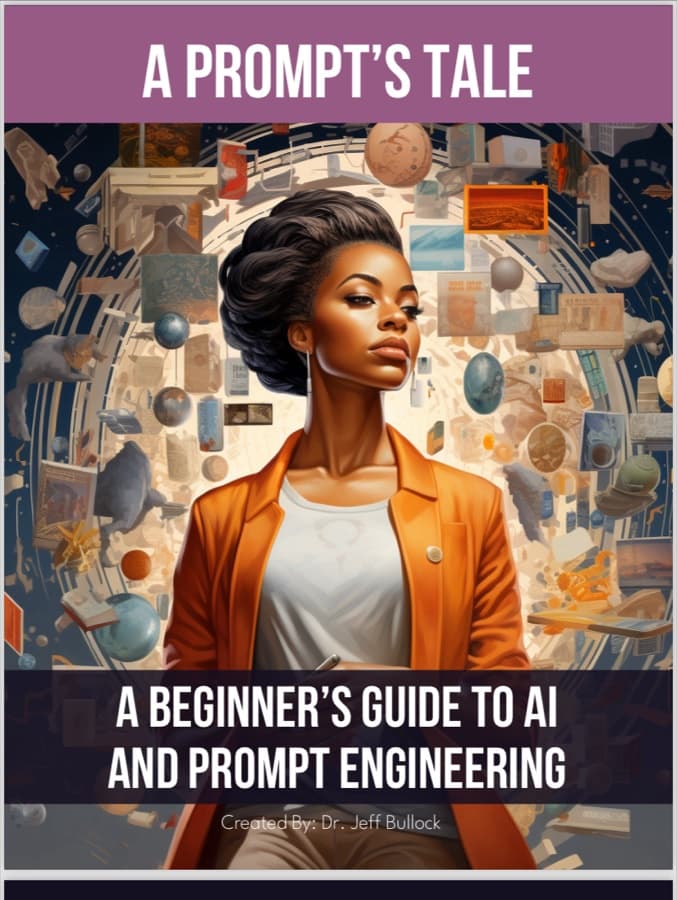
A Prompt's Tale is Dr. Jeff Bullock's beginner's guide to AI and prompt engineering, built around the story of Maya Johnson, a district pharmacy manager overseeing twenty stores. When a shipment crisis leaves her unprepared for a major presentation, her former colleague Adrian, now a trainer at PRISM AI Consultants, points her to ChatGPT.
Maya's first prompts save her presentation, and her curiosity pulls her deeper: she teaches a struggling colleague, Carlos, to use AI for team engagement and, at the end of their session, he heads home to help his son with a social studies project; she joins a local AI meetup where Raj, Ethan, Li, and Sophia show her plug-ins like VoxScript, Wolfram, Zapier, and SceneXplain; and over Thanksgiving in Atlanta she quietly uses ChatGPT to help her family, only to confront her Uncle Joe's bitterness over losing his factory job to automation. A subplot involving a rival, Linda, who had been undermining Maya out of jealousy, resolves through an apology and reconciliation.
The narrative sections give way to direct instruction: the CRAFT framework for writing effective prompts, an iterative testing process, and chapters applying prompting to education, business, personal life, and creative work. The book closes with a chapter on AI ethics drawing on Mo Gawdat, Yuval Noah Harari, and Emad Mostaque, covering job displacement, data privacy, and bias, and ends with a direct call to readers to approach AI with curiosity, responsibility, and an abundance mindset rather than fear.
Themes
- AI adoption in ordinary work and family life
- the craft of prompt engineering (the CRAFT framework)
- ethics of AI: job displacement, data privacy, algorithmic bias
- abundance mindset versus fear/greed narratives about AI
- mentorship and community learning (the PRISM forum/meetup)
- AI as a tool that amplifies human intent, not a replacement for judgment
Key Ideas
- The CRAFT method for writing prompts: Clear and specific, Relevant context, Avoid assumptions, Flexible open-ended prompts, Tone and formatting experimentation
- Prompt engineering as an iterative loop: test, analyze, refine, repeat
- AI plug-ins covered in the narrative (VoxScript, Wolfram, Zapier, SceneXplain, StoryCraft, Bramework, Advanced Data Analysis) extend ChatGPT into real-time data, math, automation, image-to-text, and code
- Applications walked through chapter by chapter: education, business strategy, data analysis, content creation, personal routines, and creative fields
- Ethics chapter built on Mo Gawdat, Yuval Noah Harari, and Emad Mostaque (with references to Elon Musk and Geoffrey Hinton): automation's effect on jobs (citing a 2019 McKinsey estimate that up to 30% of work activities could be automated by 2030, affecting roughly 800 million jobs), data privacy and consent, and algorithmic bias
- Central thesis: AI is a tool that amplifies human intent; its impact depends on how thoughtfully and ethically people use and guide it
- Maya Johnson, a pharmacy district manager whose crisis-driven first use of ChatGPT frames the whole book
- Adrian, her mentor and a trainer at PRISM AI Consultants, who introduces her to AI history, plug-ins, and ethics
Comparable To
- Solve for Happy by Mo Gawdat (directly cited in the book as an influence on its ethics chapter)
- Sapiens by Yuval Noah Harari (directly cited in the book as an influence on its ethics chapter)
Who It's For
For total beginners who want a friendly, non-technical on-ramp into prompt engineering: professionals, managers, and parents, not developers. The selling angle is that it teaches the CRAFT method through one manager's real work crisis and family life rather than a dry technical manual, then backs it with a dedicated ethics chapter citing named experts (Gawdat, Harari, Mostaque) instead of vague AI-hype talk.