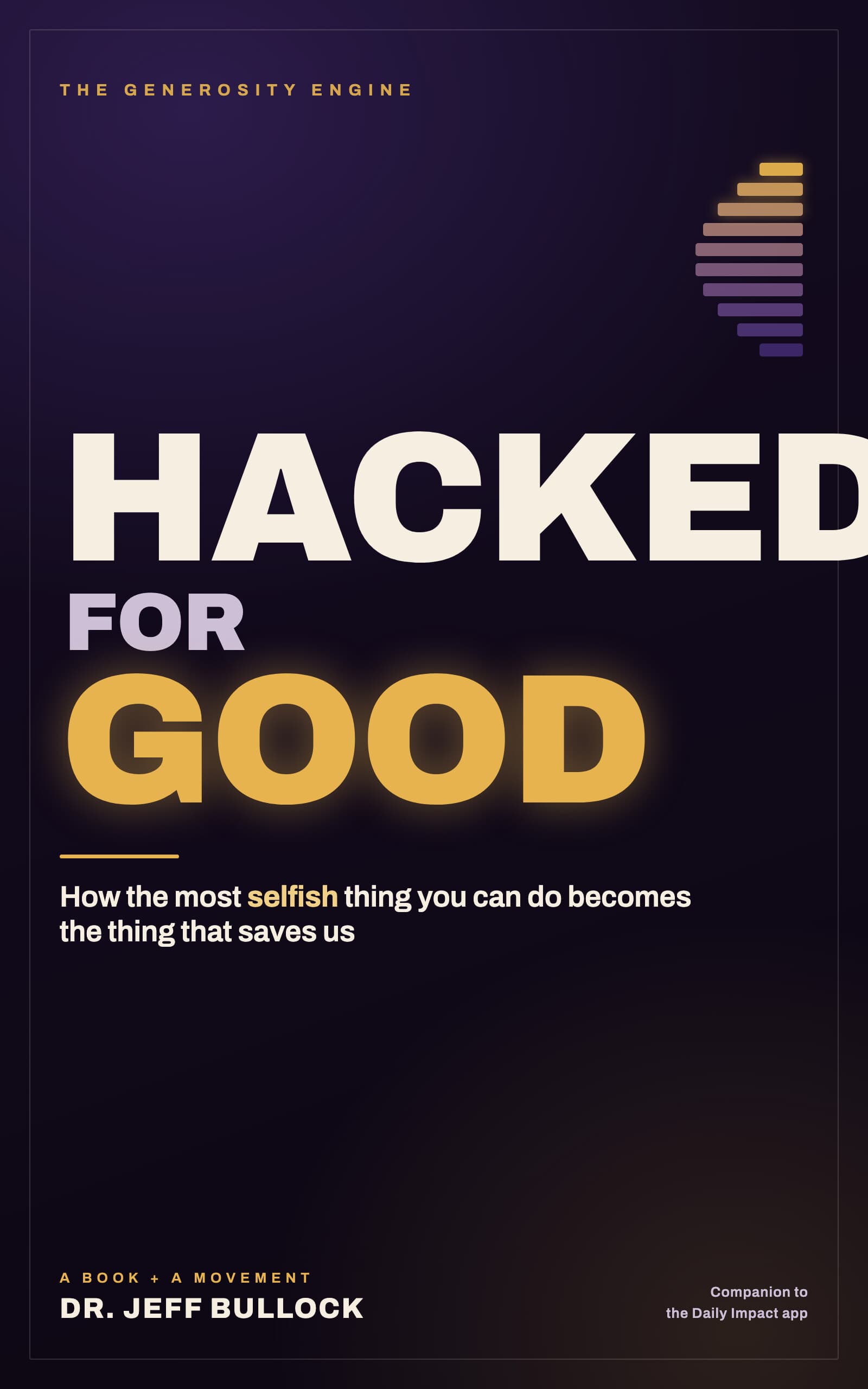
Hacked for Good argues that giving triggers the same brain reward circuitry that social media apps have spent two decades learning to exploit, and that the fix is not more willpower but better design. Dr. Jeff Bullock opens with Mansa Musa, the 14th-century Malian emperor whose unstructured gold-giving crashed Cairo's gold market, using him as both the model for generosity's power and a warning that a good heart still needs a system. Bullock walks through the neuroscience of the Helper's High (dopamine and oxytocin on firmer ground, serotonin held more loosely), the friction that kills good intentions, the four-part habit loop (cue, action, reward, investment) drawn from Duhigg and Eyal, and a five-gear "Generosity Engine" that adds contagion and cultural roots (Ubuntu, dana, zakat, potlatch) to the mix.
He argues generosity can be engineered to spread the way the Ice Bucket Challenge did, and that AI coaching built on the GROW model and motivational interviewing can replace the manipulative nudges of the attention economy with prosocial ones. The back half of the book is a full, self-critical disclosure of Daily Impact, the free giving app Bullock built himself, which routes donations through Every.org to vetted charities.
He directly raises and answers objections including manipulation, privilege, slacktivism, and moral licensing. The book closes with a fictional epilogue set in 2056, imagining two hundred million people giving daily, before returning to the real, present-day ask: open the app and give once.
Themes
- Generosity as neuroscience, not just virtue
- Habit design and behavior engineering (cue-action-reward-investment)
- Friction removal as the hidden lever in behavior change
- The attention economy's mechanics turned toward prosocial ends
- Identity formed through repeated small action, not grand gesture
- Cross-cultural universality of giving (Ubuntu, dana, zakat, potlatch, tzedakah)
- Contagion and engineered virality of good acts
- Church and community as an original 'giving network' technology
- Abundance mindset versus scarcity as fuel for generosity
- Founder transparency: full disclosure of self-interest in recommending his own product
Key Ideas
- The Helper's High: giving fires dopamine, oxytocin, and (more tentatively) serotonin, the same reward chemistry the attention economy hijacks
- Friction Is the Enemy: BJ Fogg's B=MAP model and the case that reducing the steps to give matters more than raising motivation
- The Streak: a four-beat habit loop (cue, action, reward, investment) applied to giving, with deliberate 'streak-freeze grace' so it never becomes another anxiety machine
- The Generosity Engine: five gears (Helper's High, Friction Removal, Habit Loop, Contagion, Cultural Roots and AI Coach) that mesh into one system
- Mansa Musa as recurring case study: his 1324 gold-giving that crashed Cairo's economy (heart without architecture) and his later investment in Timbuktu's Sankore and the Djinguereber mosque (giving that builds institutions)
- Make Giving Go Viral: the Ice Bucket Challenge dissected as an accidental model for engineered prosocial contagion
- Church as a Channel: congregational giving (visible, cadenced, team-based) as a giving technology older than any app
- Ubuntu, Dana, Zakat, Potlatch: four independent cultural traditions that arrived at the same conclusion about generosity and identity
- The AI Coach: GROW model and motivational interviewing repurposed as a personalized nudge toward giving instead of consumption
- Daily Impact: Bullock's own free app, routed through Every.org with no funds held by him, presented with full disclosure and a set of self-raised objections (manipulation, privilege, slacktivism, moral licensing)
- Companion relationship to his other book, Black Advantage, which Bullock repeatedly says handles the separate, larger argument about building and spreading abundance
Comparable To
- Atomic Habits by James Clear
- Hooked by Nir Eyal
- The Power of Habit by Charles Duhigg
- Nudge by Richard Thaler and Cass Sunstein
- Give and Take by Adam Grant
Who It's For
For readers who already suspect their phone is running them and want a concrete, evidence-based way to redirect that same behavioral design toward generosity instead of scrolling. The strongest selling angle is the disclosure itself: Bullock built his own app around these exact mechanics and shows precisely how it works, what he gets out of recommending it, and where the whole approach could fail, rather than just theorizing about generosity from a distance.