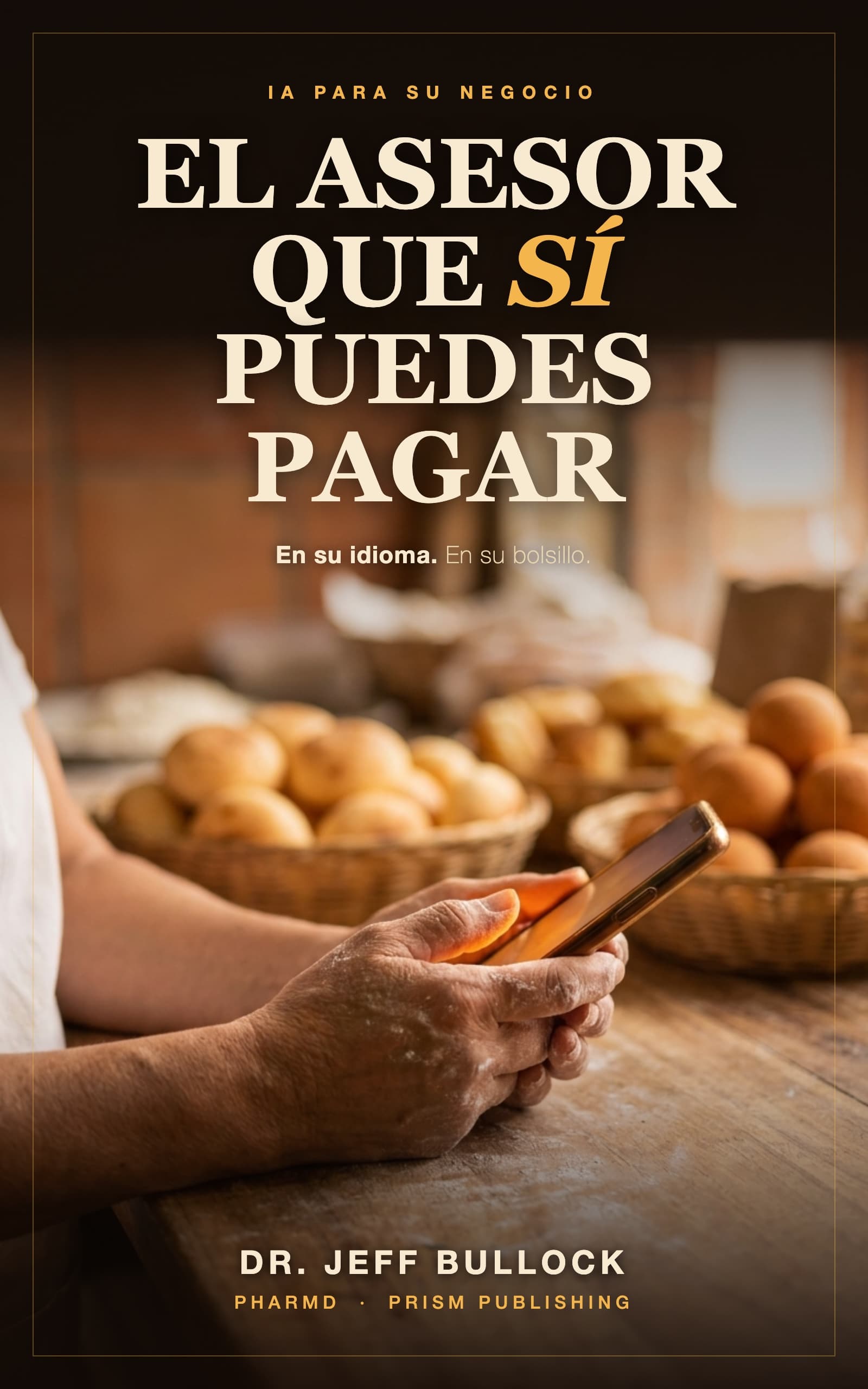
El Asesor que Sí Puedes Pagar is a Spanish-language guide for a Colombian audience, in the formal usted register, that teaches small business owners to turn a free AI tool into the advisor, translator, and coach they could never afford. Dr. Jeff Bullock, a pharmacist who climbed from cashier to district leader over eighteen years, lost about two hundred thousand dollars in a trucking venture, and founded VersAssist, then PRISM AI Consultants, delivers the method through Rosa Delgado, a bakery owner the introduction states plainly does not exist, assembled from a hundred real dueños so readers see themselves, not a stranger. Rosa is losing her bakery to a pile of mail in English she is too afraid to open; she reads fine, just not English.
She builds an AI partner chapter by chapter: reading frightening mail back in plain Spanish, saving a one-time business profile to WhatsApp, a five-part prompt framework called "La Receta" that tears down a lease and a bank rejection letter, cutting friction so the habit sticks, and twelve money-making plays across Work, Money, Customers, and Family. A final chapter sets the tool's limits: it fabricates with total confidence, so anything public, financial, or governmental gets checked by human eyes first.
Six months later the pile is gone, the loan is approved, prices are corrected upward, and Rosa teaches the first move to Marleny, the hairdresser two doors down: the advantage travels person to person, not staying with one owner.
Themes
- Fear of paperwork and the language barrier as a hidden tax on immigrant business owners
- Self-rescue and dignity over rescue by an outsider
- AI as an affordable business partner, not a toy
- Habit formation through friction reduction rather than willpower
- Financial literacy: true product costing, real pricing, formalizing a cash business
- The limits of AI judgment and where human verification is non-negotiable
- Knowledge and legacy transfer within family and community
- An advantage meant to spread neighbor to neighbor, not stay with one owner
Key Ideas
- Piece by piece: build the AI partner one capability at a time instead of waiting to master it all before starting
- La Receta (The Recipe): a five-ingredient prompt framework, Rol, Fuente, Tarea, Forma, Cerca, that turns vague requests into specific, defensible answers
- Antesala, momento, repaso: prepare before a hard conversation, record it with consent, then have the AI grade the performance honestly since no one else gives an owner that feedback
- Friction, not motivation, decides whether a tool gets used; moving an icon and enabling voice input beats willpower
- Twelve concrete plays across four batches, Trabajo, Dinero, Clientes, Familia: true costing and pricing, formalizing a business, decoding a bank rejection letter, a five-dollar-a-day ad, a WhatsApp after-hours auto-reply, preserving a grandmother's recipe and family story
- The tool has speed and no judgment; it states fabricated numbers with total confidence, so anything public, financial, or governmental gets checked before it goes out
- Privacy discipline: describe the problem, never paste account numbers, passwords, or employee and client private data
- The unfair advantage is knowing the game is even being played; it is meant to move person to person, not stay with the one who learned it first
Comparable To
- Chris Guillebeau, The $100 Startup, for the practical, no-jargon, do-this-today register
- Mike Michalowicz, Profit First, for the plain-language approach to small business money mechanics
- Reid Hoffman-style 'AI for the rest of us' guides, but built specifically for Spanish-speaking, cash-economy, immigrant-owned small businesses
Who It's For
For Spanish-speaking small business owners, especially Colombian and Latino dueños, who are intimidated by English paperwork, banks, and technology and could never afford a real advisor. The strongest selling angle: the tool is free, already on their phone, delivered in their own language and formal register, taught through a relatable composite character rather than a stranger's story, and the author's credibility rests on a documented eighteen-year operations career and a real financial loss, not an invented guru bio.