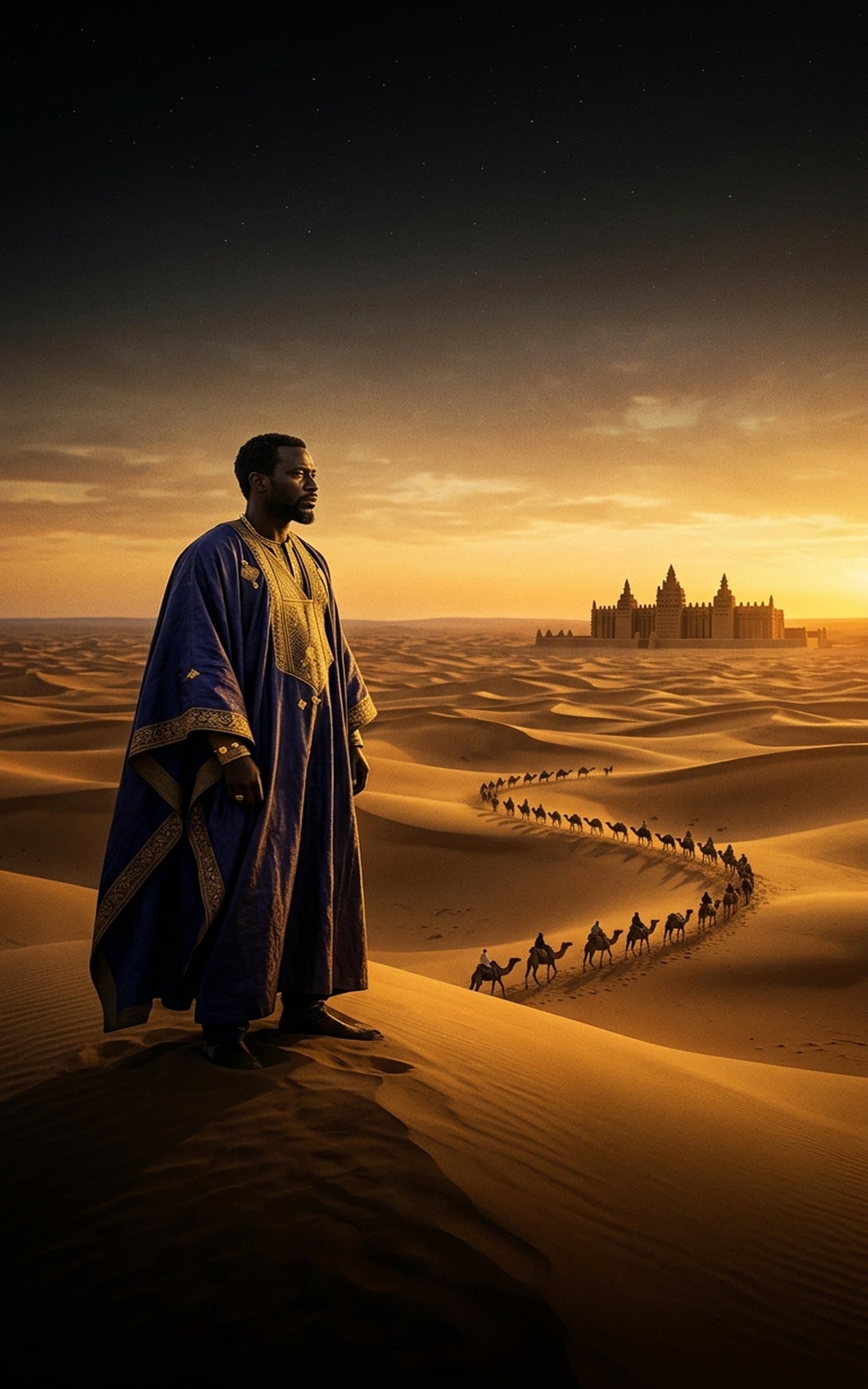
Sekou Kante is treasury architect of the Mali Empire, the man who counts Mansa Musa's gold to the mithqal. When Musa announces he intends to give away nearly the entire treasury on his hajj to Mecca so the world will never forget Mali, Sekou has to turn that ambition into logistics: sixty thousand people, sixteen tons of gold, and a crossing of the Sahara that kills roughly four thousand of them before they reach Cairo. In Cairo, Musa's generosity crashes the gold market so badly a money changer hangs himself, and Sekou is forced to borrow at ruinous rates to get the caravan home. In Mecca, circling the Kaaba, Sekou's lifelong compulsion to count breaks for the first time.
On the return, Musa conquers Gao, then pours what remains of the treasury into Timbuktu, hiring the Andalusian poet-architect al-Sahili to build the Djinguereber Mosque and the university at Sankore out of mud brick, in collaboration with local master builder Koniba Diallo. Sekou comes home to find his wife Aminata has held the treasury together alone for eighteen months and has become someone harder and more capable than the woman he left. Interludes in her voice run through the book alongside his. The back half tracks the empire's slow cooling: tribute delays, rising escort fees, Mossi raids, a treasury that never fully recovers, and a weak heir in Musa's son Maghan.
The novel closes thirty years later, in 1355, with an aged Sekou dictating this account to a young scribe in Timbuktu, having outlived Musa, the griot Nandi, al-Sahili, and his old teacher. He never resolves whether the hajj was worth its cost. Aminata's final letter tells him he's asking the wrong question.
Themes
- The gap between what can be counted and what actually matters
- Faith versus arithmetic as ways of running an empire
- What gets remembered: griots' epics versus a treasury man's ledger
- The hidden labor of the wife who holds the institution together while the man chases legacy
- Living architecture (mud brick that must be tended) versus dead monuments (pyramids, stone) that outlast their builders
- Generosity as both moral act and economic weapon that can destroy the people it's meant to help
Characters
- Sekou Kante - the narrator, treasury architect of Mali, a man who counts everything and slowly learns what counting can't hold
- Mansa Musa - the king who decides to give away nearly the entire imperial treasury to make the world remember Mali forever
- Aminata - Sekou's wife, who runs the treasury alone for eighteen months and comes back changed and harder than he is
- Nandi Kouyate - the senior griot who tells Sekou the numbers aren't the whole story and that he'll have to write it down himself someday
- Al-Sahili - the exiled Andalusian poet-architect recruited in Mecca who builds Timbuktu's mosque and university out of mud brick
- Maghan - Musa's son, left as regent during the hajj, who proves unequal to the throne he eventually inherits and loses
- Ousmane - the young scribe, thirty years later, who takes down Sekou's dictated account of the whole journey
Comparable To
- Wolf Hall by Hilary Mantel (a powerful ruler seen through the eyes of the aide who manages his ambition)
- Pillars of the Earth by Ken Follett (building as the organizing obsession of a historical novel)
- Homegoing by Yaa Gyasi (West African history rendered as intimate, generational fiction)
- The Kite Runner by Khaled Hosseini (an old narrator dictating a reckoning with his own past)
Who It's For
For readers of literary historical fiction who want the real 1324 Mansa Musa hajj (the richest man in history, the gold crash in Cairo) told from inside the caravan by the accountant who had to make the numbers work, not from the king's throne. Sells on the same shelf as Wolf Hall and Homegoing: a court insider's voice, a real historical event most readers only know as a trivia fact, and a marriage story running underneath it.