A Prompt's Power is a business book built around a fictional case study, the sequel to Bullock's A Prompt's Tale. It follows Maya Johnson, a corporate director overseeing twenty-plus pharmacy locations who also runs an AI consultancy, roughly eighteen months after the first book. When Maya's Uncle Joe dies the same week she is racing to finish the biggest client deliverable of her career, her old AI habits (typing faster, automating without thinking) start to fail her: a Zapier trigger meant to handle condolence texts misfires and sends her grieving cousin a canned LinkedIn-style networking template, and she loses a spreadsheet she needs for the funeral catering while the eulogy itself sits blank on her screen.
Her mentor Adrian walks her through a rebuild: voice capture with Otter, a NotebookLM "second brain," and a five-part prompting method Bullock calls PRISM (Purpose, Role, Information, Structure, Metrics). She uses it to win a school district contract by pitching a "Centaur Model," AI handling routine tasks while humans keep judgment and oversight, instead of the headcount-cutting automation the district board originally asked for. The narrative closes with Maya resigning her corporate job to lead the initiative full time, hiring a human assistant, Elena, for the work AI can't do, and reclaiming time with her daughter, Gigi.
The book then shifts into straight nonfiction: it defines the "Whiplash Economy" and "Adaptation Gap," surveys warnings from AI researchers Mo Gawdat, Geoffrey Hinton, and Yuval Noah Harari about optimization without empathy, lays out five principles for ethical AI design (transparency, consent, dignity, accountability, reversibility), covers AI in K-12 education and the new digital divide, and closes with a three-step "Monday Morning" action plan for readers to build their own version of the system.
Themes
- The Whiplash Economy and the Adaptation Gap between technology speed and human capacity
- The Chatbot Era vs. the Agent Era
- The Centaur Model: human judgment plus AI execution beats either alone
- Ethical AI design (transparency, consent, dignity, accountability, reversibility)
- Automation without empathy vs. automation that creates capacity for people
- Grief, presence, and keeping promises to family while under professional pressure
- Raising an AI-native generation to direct AI rather than be replaced by it
Key Ideas
- The Whiplash Economy: the widening gap between how fast AI advances and how fast humans can adapt
- Chatbot Era vs. Agent Era: tools you prompt one step at a time vs. autonomous agents that pursue a goal on their own
- The Centaur Model: drawn from post-Deep Blue freestyle chess, where a human plus AI consistently beats a lone AI
- PRISM prompting framework: Purpose, Role, Information, Structure, Metrics
- Warnings from AI's own builders: Mo Gawdat's 'Pain Gap,' Geoffrey Hinton's subgoal problem, Yuval Noah Harari on AI and hackable humans
- Five Principles of Ethical AI Design: transparency, consent, dignity, accountability, reversibility
- A case-study narrative: Maya Johnson, a corporate pharmacy operations director and AI consultant, works through her Uncle Joe's death and a career-defining school district pitch to decide whether her AI system will cut jobs or free people up
- A three-step 'Monday Morning' plan for readers: voice capture, a second-brain knowledge base, and delegating one task to an agent
Comparable To
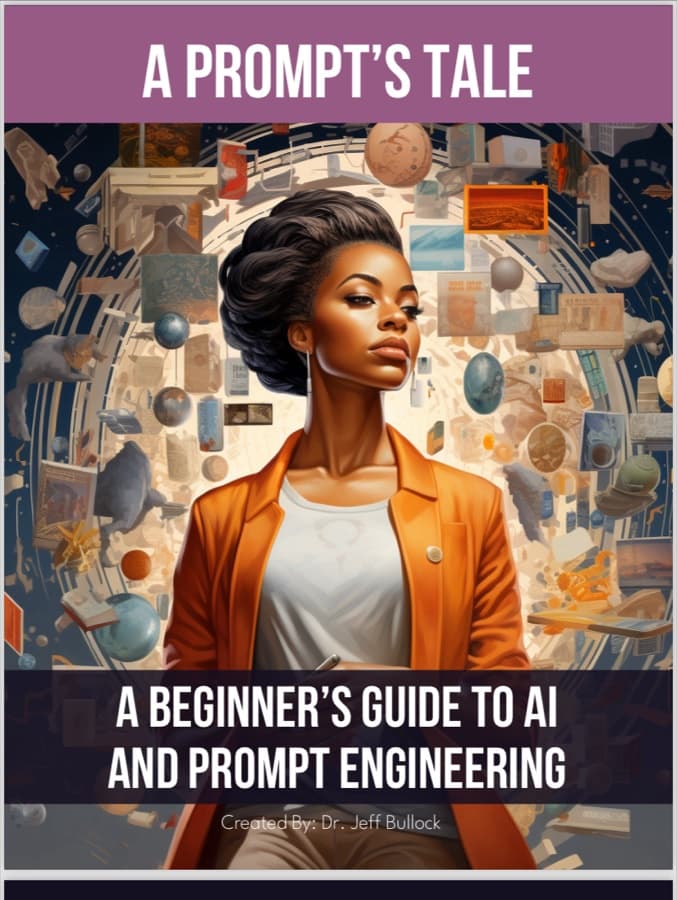
- A Prompt's Tale (Dr. Jeff Bullock's first book, direct predecessor)
- The Goal by Eliyahu M. Goldratt
- Co-Intelligence by Ethan Mollick
- Prediction Machines by Ajay Agrawal, Joshua Gans, and Avi Goldfarb
Who It's For
For readers who already use AI and want to stop typing faster and start building systems: consultants, managers, and busy parents feeling the pace of change. The strongest angle is that it teaches a concrete, reusable prompting framework (PRISM) and a named model (Centaur) through a story with real stakes, then backs it with named warnings from AI researchers and a specific three-step plan a reader can run the next morning.