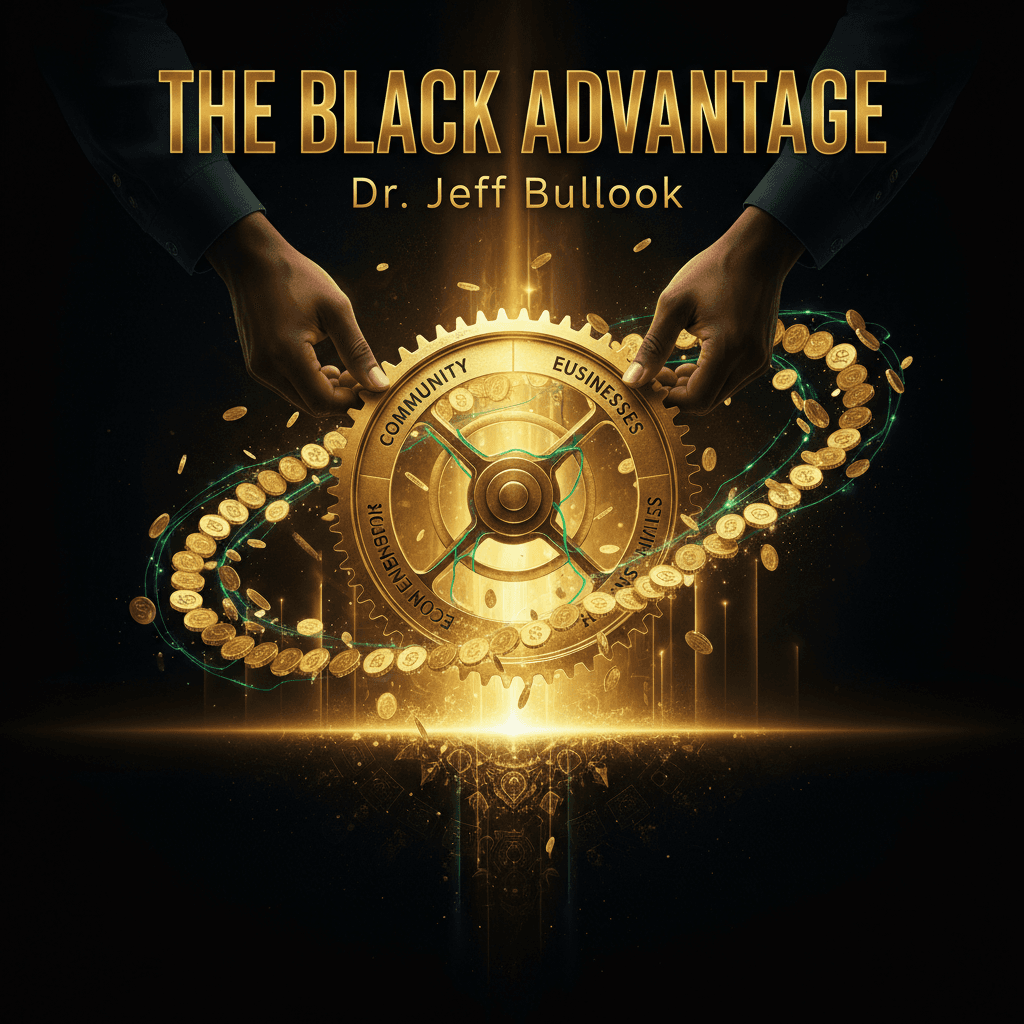
Dr. Jeff Bullock, a pharmacist who spent eighteen years climbing from CVS clerk to district leader, argues that Black poverty is not a character flaw but an engineered system: four interlocking "gears" (asset devaluation, capital exclusion, underfunded infrastructure, and extraction itself, illustrated by a dollar that survives only six hours in most Black neighborhoods) that together cost the economy an estimated $16 trillion over twenty years. His counter-thesis, the "Black Advantage," argues that the same 400 years of adversity forged measurable cognitive assets (code-switching as executive function, pattern recognition under uncertainty, "Jugaad" innovation under constraint) that are now valuable in an AI-reshaped economy.
The book's solution is the "Abundance Flywheel," a five-gear operating system built on retention, circulation, and distributed governance rather than charisma or charity, deployed through real tools: a fintech app called the Dollar Router (live at dollarrouter.app), a digitized rotating-savings circle called the Digital Susu, and a plan for buying retiring Boomer-owned "Silver Tsunami" small businesses via SBA loans instead of founding startups from scratch. Governance chapters build in salary caps, transparency dashboards, and "kill-switches" explicitly designed to prevent the book's own system from curdling into the nonprofit "Poverty Pimp Trap" it criticizes.
The book closes with a 2045 vision built around a composite figure, Calvin Brooks, and appendices containing an illustrative Allentown pilot plan, a sourced evidence stack, and ready-to-use legal templates.
Themes
- Poverty as engineered economic architecture, not individual failure
- Adversity-forged cognitive assets (antifragility, code-switching, pattern recognition) as an undervalued asset class
- Retention and circulation velocity of money over top-line income or grants
- AI as a cost-collapsing equalizer for capital-poor builders
- Buying existing cash-flowing businesses (the 'Silver Tsunami') over founding risky startups
- Trust as measurable, deployable infrastructure (the Black Church, HBCUs)
- Governance and 'kill-switches' designed to prevent charity/nonprofit incentive traps
- Diaspora economic bridge-building between Black America, Africa, and the Caribbean
Key Ideas
- Dr. Jeff Bullock (the author), pharmacist turned systems architect who frames the whole book around the gap between his own success and his extended family's stagnation
- The Four Gears of the Vicious Cycle, asset devaluation, capital exclusion, underfunded infrastructure, and extraction, presented as a closed, self-reinforcing loop
- The Black Advantage thesis, cultural capital, trust networks, and the diaspora bridge, underwritten by the 'Hidden Talents' cognitive-science framework and a 2026 JAMA Network Open study on HBCU cognitive outcomes
- The Abundance Flywheel, a five-gear economic operating system (relational capital, dense business formation, capital circulation, workforce upskilling, AI-and-cooperative scale)
- The Dollar Router and Digital Susu, a real, deployed fintech app (dollarrouter.app) and a digitized rotating-savings circle that together track spending and build alternative credit history
- The Ownership Pipeline, acquiring retiring Baby Boomer-owned 'Silver Tsunami' businesses via SBA 7(a) loans, illustrated through the explicitly labeled composite figure Calvin Brooks
- Governance and Kill-Switches, salary caps, an Administrator-to-Operator Ratio, and automatic funding cutoffs built to stop the system from becoming the 'Poverty Pimp Trap' nonprofit model it critiques
Comparable To
- PowerNomics by Claude Anderson (named directly in the text as intellectual predecessor)
- The Color of Money by Mehrsa Baradaran
- Poverty, by America by Matthew Desmond
- Antifragile by Nassim Nicholas Taleb (framework explicitly borrowed and applied)
- Good to Great by Jim Collins (the flywheel concept is explicitly adapted from this book)
Who It's For
Written for the person the author calls "the Builder": roughly 40 to 60 years old, already the most successful person in their extended family, with some capital, some standing, and a running frustration that individual generosity never fixes the structural gap at the Thanksgiving table. The strongest selling angle is that this is not another motivational read: it ships with a live fintech app, a governance charter, legal templates, job descriptions, and a sourced evidence appendix, written by a practitioner who names his own city (Allentown, PA) as the pilot site rather than a hypothetical case study.