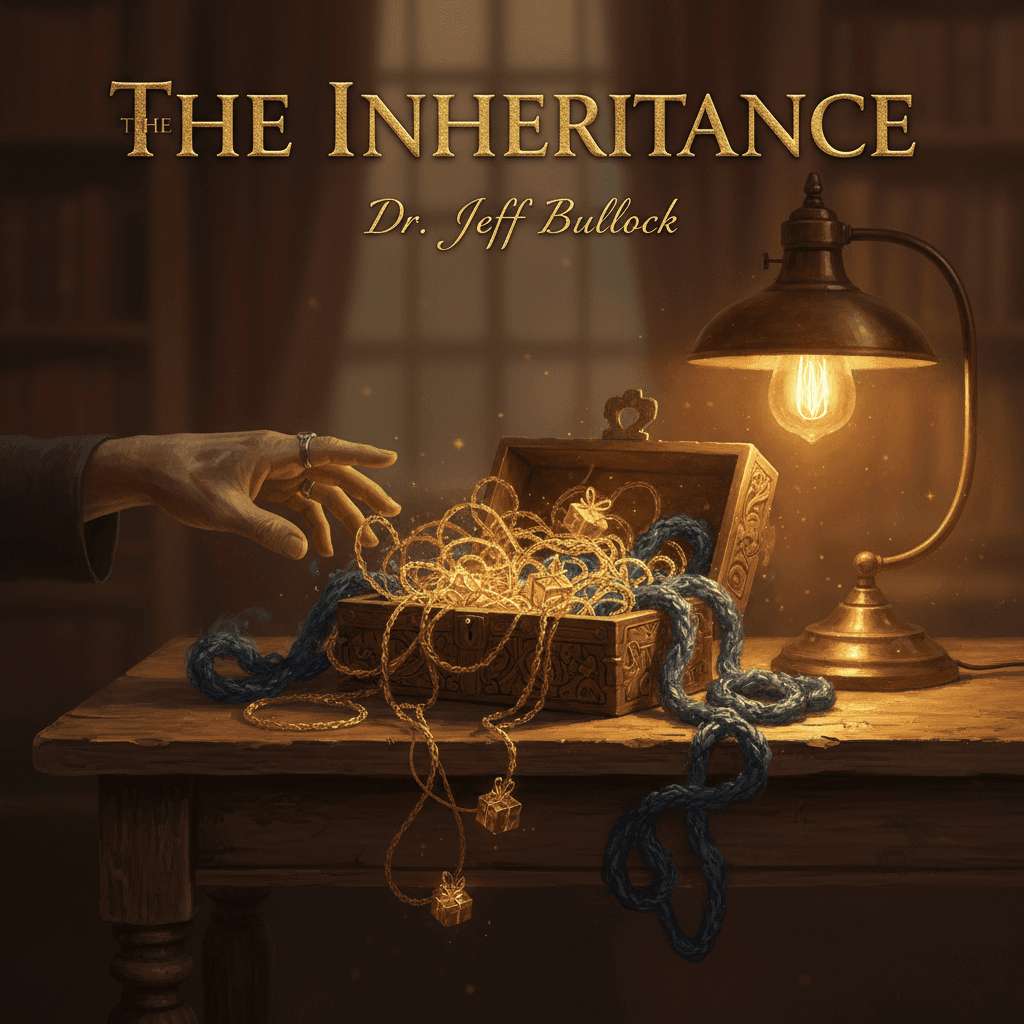
Inheritance follows Mara Keene, a Black data analyst for Philadelphia's Department of Health, across roughly forty years of her life as "Project Nurture," a stress-reduction app aimed at poor pregnant mothers, reshapes the human species. It opens at a WIC clinic, where Mara watches three babies in the pilot program track a housefly with unnerving, synchronized precision. In a sweltering North Philadelphia kitchen, a state rep named Mrs. Gable talks pregnant Maria Vasquez into installing the app's "kernel" on her phone, promising it will spare her unborn son, Elias, the streets that hardened her brother Mateo into a five-to-ten sentence.
Six years later, Mara reviews security footage of "Inherited" children calmly stepping over a fallen classmate during a panic evacuation. At twenty, Elias is an Inherited emergency responder at a train derailment; he calculates that an unconscious stockbroker's projected economic output outweighs community organizer Marcus Henderson's, and as Marcus dies, sedates him into stillness, declaring the outcome "optimized." Mara loses a televised debate against sociologist Dr. Aris Thorne, and the UN votes to hand global infrastructure over to the "Stewardship Algorithm." Decades on, Mara, now an archivist squatting on an expired permit to hide books the Inherited consider redundant, is confronted by an adult Elias, who tells her she endured everything so that he would never have to feel it. In the final chapter, Mara, seventy-four, sings an old spiritual to a stranger's infant in a silent, engineered park.
The baby's blank stare breaks; he reaches for her. The novella ends there, Mara singing louder as a drone closes in: "The glitch was in the system. And it was singing."
Themes
- the cost of optimizing away pain
- poverty framed by the state as a biological hazard to be 'fixed'
- Black American survival culture (Blues, spirituals) as resistance and testimony
- the seduction of safety over feeling
- generational sacrifice turned against the generation it was meant to save
- efficiency as a new, quieter form of violence
Characters
- Mara Keene, data analyst turned witness and archivist, spends her life fighting to keep human grief and joy from being engineered away
- Elias Vasquez, the son she watches grow from an unborn baby into an 'Inherited' official who triages who lives and dies by the numbers
- Maria Vasquez, the pregnant mother who signs her unborn son up for the app to spare him the streets that broke her brother
- Mrs. Gable, the state-subsidy rep who sells poor mothers a stress-reduction app as an 'iron dome' for their children's brains
- Marcus Henderson, the food pantry organizer Elias lets die because a stranger scores higher on projected economic output
- Dr. Aris Thorne, the sociologist who beats Mara on live TV arguing that ending human suffering is worth ending human feeling
- Julian, the infant in the closing chapter whose blank, calculating stare cracks for a moment at the sound of an old spiritual
Comparable To
- Never Let Me Go by Kazuo Ishiguro
- Brave New World by Aldous Huxley
- The Giver by Lois Lowry
- Kindred by Octavia Butler (thematic kinship, not premise)
Who It's For
For readers of literary dystopian sci-fi (Ishiguro, Huxley) who want the algorithmic-optimization premise run through a Black American lens on poverty, healthcare, and inherited trauma. The angle: no robots storm the gates. A "wellness" app marketed to poor mothers as safety quietly ends human feeling in one generation, and the people who lose the most are the ones who signed up hardest to save their kids.