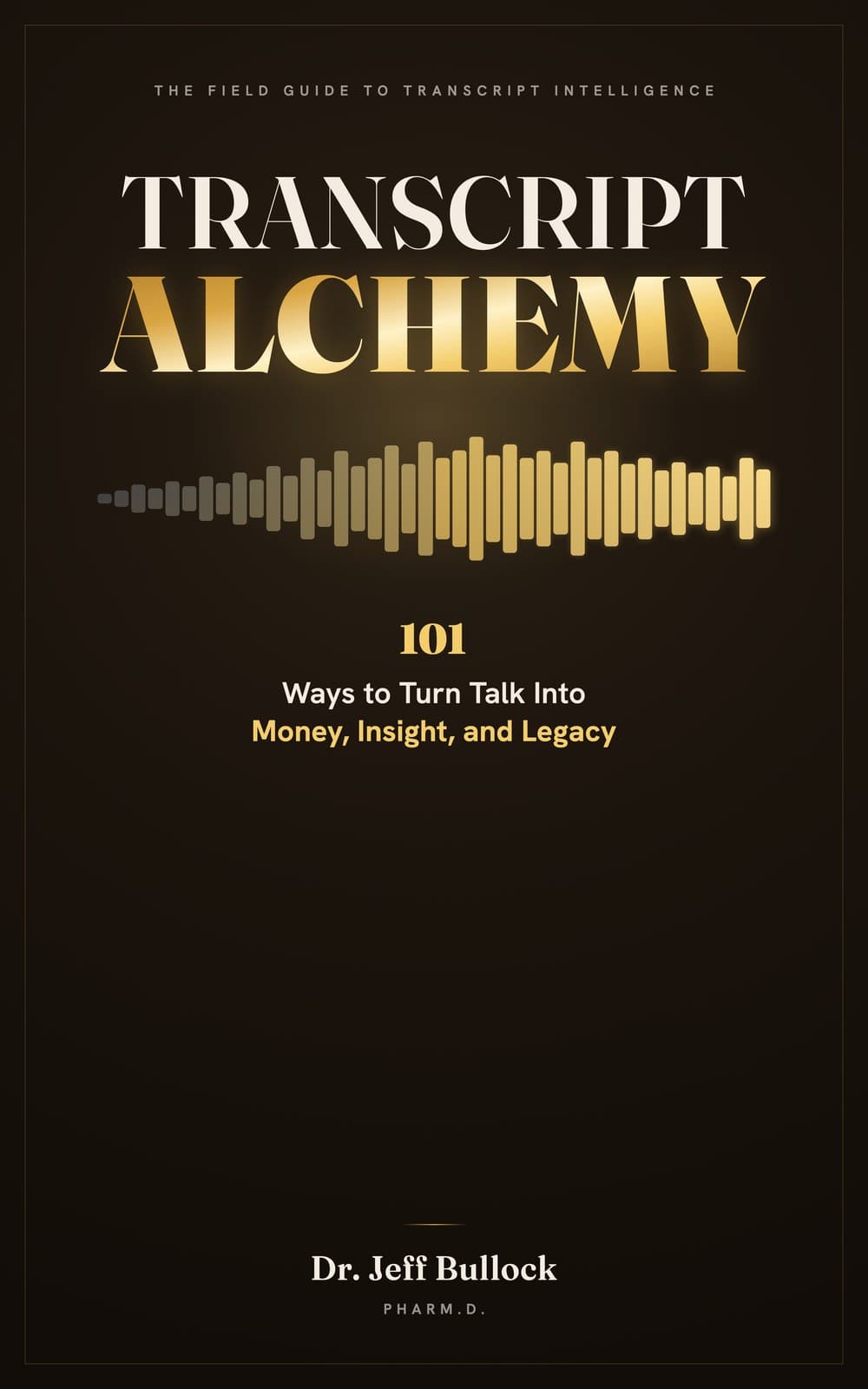
Transcript Alchemy is a non-fiction field guide, not a tour of AI possibility but an execution manual. Its thesis: a transcript of any conversation, once captured, is a database you can question with the right prompt, and doing this consistently builds "Conversational Capital," a compounding asset competitors cannot copy because they were not in the room. The book opens with the origin of its own title, a line Bullock said in a meeting and only kept because the meeting was being transcribed.
Part 0 covers how to capture a transcript from any situation in about sixty seconds, plus a plain-English rundown of consent and recording law. Part 0.5 teaches the core skill: a five-part prompt structure (Role, Source, Task, Format, Fence) and the "Stress Test," a grade-me-out-of-ten prompt Bullock ran on his own meetings and got a six. Part 0.6 is an honest limits chapter on AI fabrication, archive privacy, and where human judgment must stay human.
Parts I through IV apply the same skill to sales and marketing, content, coaching, leadership, self-coaching, relationships, parenting, creative writing, strategy, and finally legacy work: turning a grandparent's stories into an autobiography, building a family historian bot, preserving a loved one's voice, and recording a time-capsule letter. The closing chapter names the underlying loop, "Speak, Analyze, Act, Repeat," and "The Vault" catalogs all 101 plays with prompts, 2026 tool stacks, and an industry index.
Themes
- Talk as an underused, perishable asset
- Memory as faulty and self-flattering versus the transcript as an honest record
- One prompting skill applied across work, self, craft, and family
- Guardrails against AI fabrication (the Fence: quote real lines, never invent)
- Consent and privacy as non-negotiable before recording others
- Compounding advantage from a captured archive (Conversational Capital)
- Taste, judgment, and accountability as the human's remaining job
Key Ideas
- Conversational Capital: the compounding, un-copyable asset built by consistently capturing and mining your own conversations
- The Method (Role, Source, Task, Format, Fence): the five-part prompt structure underneath every play in the book
- The Fence: the standing instruction to use only what is in the transcript, quote real lines, and flag rather than invent gaps
- The Stress Test: the 'grade me out of ten' prompt Bullock calls the gateway play, and the one that gave him a six on his own meetings
- Anonymizing to Person A / Person B: stripping names before analyzing tense or relationship conversations to get a neutral read
- Speak, Analyze, Act, Repeat: the closing loop that frames all 101 plays
- The Legacy plays: grandparent autobiographies, a family historian bot, preserving a loved one's voice, and time-capsule letters, run with explicit consent rules
Comparable To
- Co-Intelligence by Ethan Mollick
- Building a Second Brain by Tiago Forte
- They Ask, You Answer by Marcus Sheridan
Who It's For
For founders, salespeople, coaches, consultants, and parents who already record their calls and conversations and never go back to read them. The strongest angle: this is not another book selling the idea that AI is powerful, it hands over 101 copy-paste prompts with a built-in honesty guardrail, so you can run one on a real transcript this afternoon and see a result by tonight.