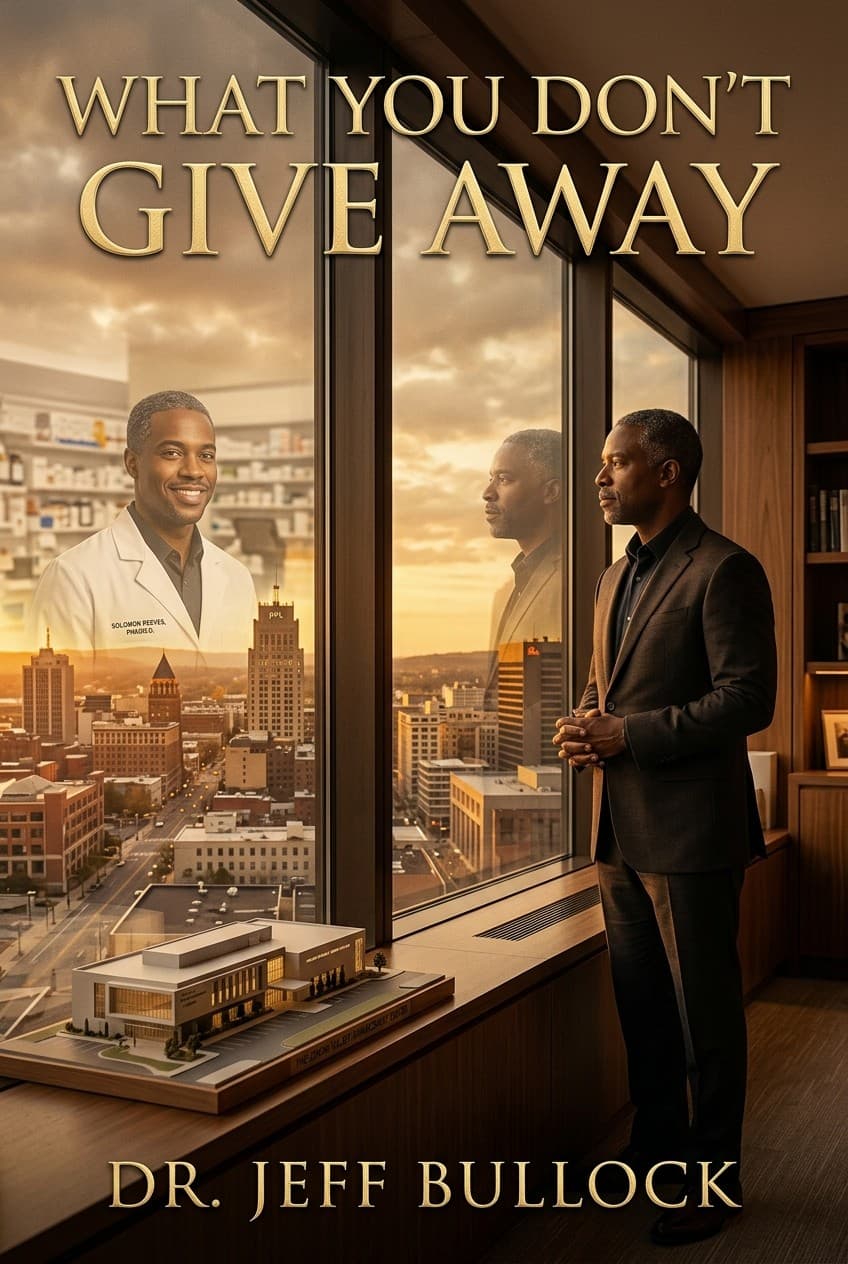
Solomon "Sol" Reeves is a pharmacist in Allentown, Pennsylvania who quits his job in 2026 after his mother Dorothy, a home health aide, dies having given $126,000 over thirty years to a church whose pastor drove a Lincoln while she rode the bus. Sol builds the Dollar Router, an app that shows a fifteen-block Black neighborhood how fast money leaves it (six hours) and how to make it circulate (forty-eight hours). Over three decades this grows into the Flywheel: savings circles, worker-owned business buyouts, a reentry program that trains incarcerated men like Darius Cole for trade jobs, and eventually a global giving app used by millions, built on the neuroscience of generosity and adapted to different cultures' giving traditions.
The cost is his family. His wife Amara, a nurse, and daughter Zuri watch him miss recitals, birthdays, and a law school acceptance call while he chases the next city. What no one knows, until journalist Nina Okafor's investigation breaks it, is that Sol has spent fourteen years secretly logging into an admin account at 3 a.m. to override the platform's supposedly autonomous algorithm 11,432 times, unable to trust anyone's judgment but his own the way the world once failed to protect his mother's open hand.
The novel ends with Sol writing an unarchitected check to his aunt at a Thanksgiving table, deactivating his admin access for good, retiring to a backyard garden, and getting an anonymous haircut at the barbershop where it all started, finally letting someone else hold the clippers.
Themes
- Generosity versus control
- Systems versus presence
- Race and economic extraction/wealth-building
- Fatherhood and absence
- Trust and the difficulty of letting go
- Cultural translation of giving traditions
- Technology, surveillance, and hidden power
- Grief and inheritance across generations
Characters
- Solomon "Sol" Reeves - pharmacist turned social entrepreneur who builds a global giving platform to fix what he believes exploited his mother, then can't stop secretly controlling it
- Dorothy Reeves - Sol's mother, a home health aide who gave 15% of her salary to church for thirty years and died owning nothing; the moral ghost of the book
- Amara Reeves - Sol's wife, a nurse who stays present for her patients and family, turns down a prestigious Philadelphia hospital job, and eventually tells Sol to let go
- Zuri Reeves - Sol and Amara's daughter, a lawyer who builds her own version of the Flywheel in Philadelphia deliberately without her father's help
- Darius Cole - formerly incarcerated man Sol recruits through the reentry program, becomes an HVAC technician and part-owner, and documents Sol's secret overrides because he refuses to live inside another hidden system
- Cecil Washington - Allentown barber who tells Sol "a system ain't a person"
- Nina Okafor - investigative journalist who spends a decade uncovering and reporting Sol's secret control of the platform
- Kwame Asante - Sol's technical co-builder who calls him out for being "a monarchy wearing a hoodie"
Comparable To
- An American Marriage by Tayari Jones
- The Turner House by Angela Flournoy
- The Every by Dave Eggers
- Homegoing by Yaa Gyasi
Who It's For
For readers of Black family literary fiction who also want a founder story: fans of multi-generational sagas about inheritance and home, plus readers who like tech-platform critique novels. The hook is structural, a journalist's decade-long investigation frames a "beloved philanthropist" as an unreliable narrator who has been secretly rigging his own "autonomous" system, and the emotional spine is a mother's $126,000 that never should have left her hands.